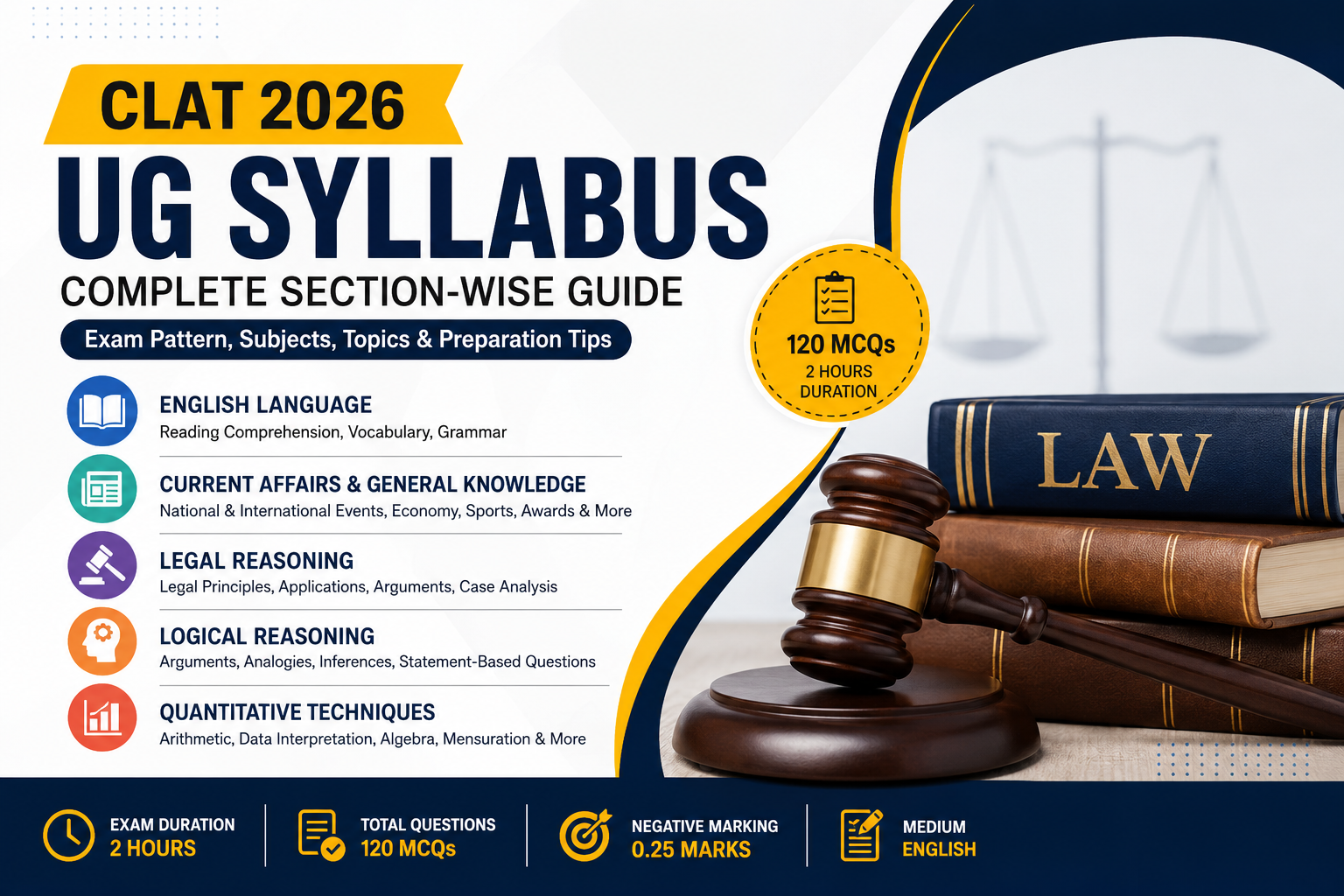
CLAT 2026 UG Syllabus – Complete Section-Wise Guide
Preparing for the CLAT 2026 Undergraduate (UG) examination requires a thorough understanding of the latest syllabus and exam pattern. The Common Law Admission Test (CLAT) is conducted for admission to undergraduate law programmes offered by participating National Law Universities (NLUs) across India.
The examination focuses on evaluating a candidate’s reading comprehension, analytical thinking, logical reasoning, and problem-solving abilities rather than testing prior legal knowledge. According to the official syllabus, the paper consists of 120 multiple-choice questions to be completed in 2 hours, with 1 mark awarded for each correct answer and 0.25 marks deducted for every incorrect answer.
CLAT 2026 Exam Pattern
| Particular | Details |
|---|---|
| Examination Mode | Offline (Pen & Paper) |
| Duration | 2 Hours |
| Total Questions | 120 |
| Question Type | Multiple Choice Questions (MCQs) |
| Marks per Question | 1 Mark |
| Negative Marking | -0.25 for each wrong answer |
| Medium | English |
Subjects Included in CLAT 2026 UG
The examination consists of five major sections:
- English Language
- Current Affairs including General Knowledge
- Legal Reasoning
- Logical Reasoning
- Quantitative Techniques
1. English Language
This section assesses your ability to understand passages and interpret written information effectively.
Skills Tested
- Reading comprehension
- Understanding arguments and viewpoints
- Drawing logical conclusions
- Vocabulary in context
- Summarising passages
- Comparing different opinions
- Understanding tone and purpose
Preparation Tips
- Read newspapers daily.
- Practice editorial reading.
- Improve vocabulary through context.
- Solve comprehension passages regularly.
2. Current Affairs & General Knowledge
This section tests awareness of recent national and international events along with general knowledge.
Important Areas
- National News
- International Affairs
- Government Policies
- Economy
- Awards & Honours
- Sports
- Science & Technology
- Environment
- Important Legal Developments
- Static General Knowledge
Preparation Tips
- Read newspapers daily.
- Follow monthly current affairs magazines.
- Revise important events regularly.
- Practice current affairs quizzes.
3. Legal Reasoning
The Legal Reasoning section evaluates analytical reasoning using legal principles provided within the passage. It is designed to assess reasoning skills rather than prior knowledge of law, although familiarity with current legal issues may be beneficial in some cases.
Skills Tested
- Applying legal principles
- Understanding legal scenarios
- Identifying arguments
- Analysing legal facts
- Drawing logical conclusions
Preparation Tips
- Practice legal reasoning passages.
- Read landmark legal developments.
- Improve analytical thinking.
- Solve previous years’ questions.
4. Logical Reasoning
Logical Reasoning measures your ability to analyse arguments and identify logical relationships.
Topics Covered
- Critical Reasoning
- Arguments
- Assumptions
- Conclusions
- Analogies
- Cause and Effect
- Inference
- Statement-Based Questions
- Logical Analysis
Preparation Tips
- Practice reasoning sets daily.
- Focus on passage-based questions.
- Learn common logical fallacies.
- Improve reading speed.
5. Quantitative Techniques
This section is based on elementary mathematics and interpretation of numerical information.
Important Topics
- Ratios & Proportion
- Percentages
- Profit & Loss
- Average
- Time & Work
- Speed, Time & Distance
- Simple Interest
- Compound Interest
- Data Interpretation
- Tables
- Graphs
- Charts
Preparation Tips
- Strengthen basic arithmetic.
- Practice data interpretation.
- Improve calculation speed.
- Solve previous year questions.
Section-Wise Weightage (Approximate)
| Section | Approximate Questions |
|---|---|
| English Language | 22–26 |
| Current Affairs & GK | 28–32 |
| Legal Reasoning | 28–32 |
| Logical Reasoning | 22–26 |
| Quantitative Techniques | 10–14 |
The distribution may vary slightly depending on the examination.
Best Preparation Strategy for CLAT 2026
Develop Reading Habits
Read quality newspapers and editorials daily to improve comprehension and current affairs knowledge.
Solve Mock Tests
Attempt full-length mock tests every week to improve speed and accuracy.
Practice Previous Year Papers
Analyse previous CLAT papers to understand the examination pattern and question types.
Focus on Time Management
Allocate fixed time for each section during practice.
Revise Regularly
Maintain concise notes for current affairs, legal developments, and formulas.
Recommended Study Resources
- National newspapers
- Monthly current affairs magazines
- Previous year CLAT papers
- Legal reasoning practice books
- Mock test series
- Reading comprehension practice material
Frequently Asked Questions (FAQs)
Is prior legal knowledge required for CLAT 2026?
No. The Legal Reasoning section is intended to assess your ability to apply legal principles provided in the passages rather than your prior knowledge of law, though awareness of current legal developments may sometimes be helpful.
How many questions are asked in CLAT 2026 UG?
The examination consists of 120 multiple-choice questions.
Is there negative marking?
Yes. 0.25 marks are deducted for every incorrect answer.
What are the five sections of CLAT UG?
The five sections are:
- English Language
- Current Affairs including General Knowledge
- Legal Reasoning
- Logical Reasoning
- Quantitative Techniques
How much time is allotted for the examination?
Candidates are given 2 hours to complete the examination.
Conclusion
Success in CLAT 2026 depends on consistent preparation, strong reading comprehension, logical thinking, and regular practice. Since the examination is passage-based and aptitude-focused, candidates should prioritise understanding concepts over rote memorisation. A disciplined study plan, regular mock tests, and continuous revision can significantly improve performance and increase the chances of securing admission to a top National Law University (NLU).